
How to Get Cat Pee Out of Carpet (and Stop the Smell Coming Back)
By Sophie Winslowe • Updated November 2026 • 11 min read
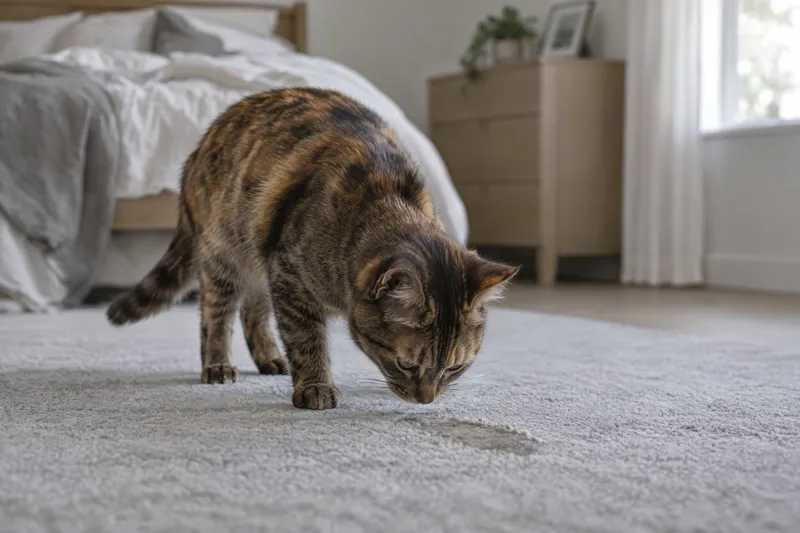
Cleaning the spot is the easy part. Getting rid of the smell for good means reaching every layer the urine soaked into, then fixing the reason your cat went there in the first place.
This guide walks through the whole job: how to treat a fresh accident, how to handle an old or humid-weather smell, what to avoid, when the padding has to go, and how to stop it happening again.
Key takeaways
- Blot first, never rub. Pull as much urine out as you can before treating anything.
- Treat to the depth of the urine. Use an enzymatic pet-urine cleaner generously enough to reach the padding, and follow the label's dwell time.
- Humidity can bring the smell back. Dried urine residue can sit quietly and then become noticeable again when the air turns damp.
- Skip steam, heat and bleach. Heat can set the stain and smell, and bleach is dangerous around urine.
- Dry fully, then recheck on a humid day. A smell that returns after complete drying points to urine still in the padding or subfloor.
- Fix the cause too. Vet check, enough litter boxes, and no punishment.
In this guide
Why Cat Urine Is So Hard to Remove
The visible spot is often only the top of a bigger problem. Urine moves down through the carpet pile and backing into the padding, and sometimes on into the subfloor. The Carpet and Rug Institute (CRI) warns that complete odor removal is unlikely unless the urine itself is removed from all the affected layers, and that odor can seem to vanish and then return when humidity rises if residue remains.
Humidity is the other half of the story. When urine dries it leaves a residue of uric acid crystals and salts, and that residue can take on moisture and give off its sharp smell again on humid or damp days, even weeks after the spot smelled fine. This is why a carpet can seem clean when dry and sour on a sticky afternoon, and why products that only mask the smell so often fail (see PetPlace and Hill's Pet).
A fresh-smelling carpet and a genuinely clean one are not always the same thing.
Rain, a damp mop, running the air conditioner or simply a sticky afternoon can be enough to bring the smell back. That is why a good test is to recheck the area once it is completely dry, and again during a humid spell.
Step 1: Find Every Affected Spot
Before you open a bottle, work out how far the problem goes. Check by smell at floor level, press clean white towels around the edge of any damp patch, and check skirting boards, sofa skirts and doorway edges.
A UV blacklight in a darkened room can help locate older spots. Mark each glowing patch with painter's tape before the lights come back on. Treat the glow as a map, not proof: laundry brighteners, some carpet backings, mineral deposits and food spills can glow too, and very fresh or heavily diluted urine may barely show.
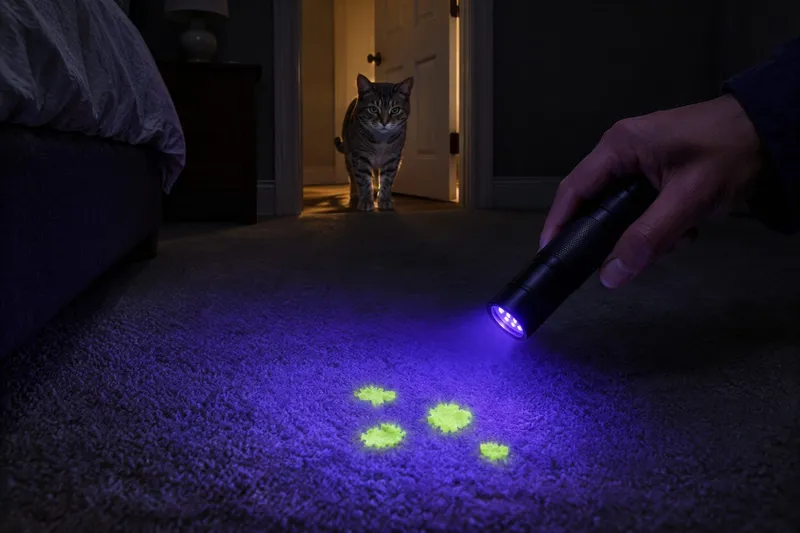
Also identify your carpet fiber, and test any product on a hidden corner first. Wool needs particular care: use only products labeled safe for wool, cold water, and a thorough cold rinse afterward.
Step 2: Treat a Fresh Accident
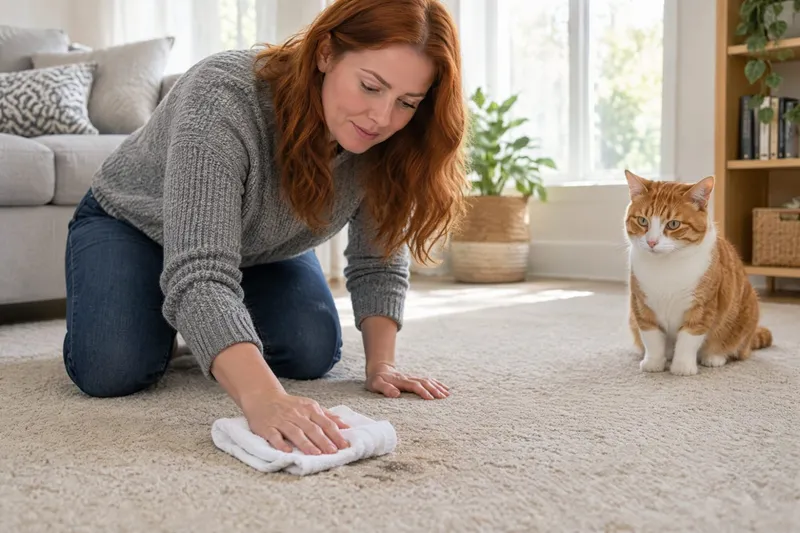
The key point is depth. Enzymatic cleaners can only work on urine they actually touch, so a light mist on the fibers will not deal with urine sitting in the padding. If you have already used another cleaner, rinse it out with plain water and blot dry first, because leftover products can interfere. (How enzymatic cleaners work and how to choose one.)
Dry the carpet as fast as you reasonably can with fans and a dehumidifier or air conditioning, not heaters, ideally within a day or two. Carpet and padding that stay wet for longer invite mold. Keep your cat off the area until it is dry, since ASPCA advises keeping pets away from enzyme-cleaned areas until they have dried.
Step 3: Treat Old or Dried Urine
Old spots are harder because the urine has had time to soak through. Work through them methodically:
- Map and vacuum. Mark the spots, then vacuum up dust and debris.
- Rehydrate if the label allows. Some products are applied to a damp area, others to dry. Follow the bottle.
- Saturate to the padding. Use enough product to reach the full depth the urine did, and extend beyond the visible edge.
- Keep it wet for the label time. Covering the area with plastic wrap or a damp towel can stop it drying out too soon, if the label permits. Do not add other cleaners to boost it.
- Extract and dry. Use a wet/dry vacuum if the label says to, then dry fully.
- Recheck. Smell the area at floor level once dry, and again on a humid day. Old spots sometimes need a second treatment.
Judge the result only when it is dry
Odor while a fragranced cleaner is still wet tells you little. A smell that persists after complete drying is a stronger sign that urine is still in the padding or subfloor.
What Not to Use
Avoid
- Steam or hot extraction on the first treatment. CRI says heat can set urine stains and smell.
- Chlorine bleach. It does not solve the urine problem and is hazardous with it.
- Ammonia cleaners. They resemble urine and can encourage re-marking.
- Strong fragrances and essential oils. Cats are sensitive to many of them.
Limited use
- Vinegar and baking soda may help with a fresh spill or surface smell, but they are not reliable for urine in padding.
- 3% hydrogen peroxide may help with leftover staining on suitable light synthetic carpet after cleaning, but it can remove color. Patch test first and avoid wool.
One chemistry at a time is the safe rule. Never mix bleach with ammonia or with acids such as vinegar, because that can release toxic gases (Washington State Department of Health guidance). The CDC advises not mixing bleach or disinfectants with other cleaners at all. Ventilate the room, wear gloves, and keep children and pets out of the work area.
When It Has Reached the Padding or Subfloor
If the smell survives two or three correct treatments, or comes back in humid weather after the carpet is fully dry, stop spraying from above and look underneath. Padding is highly absorbent and hard to treat evenly from above.
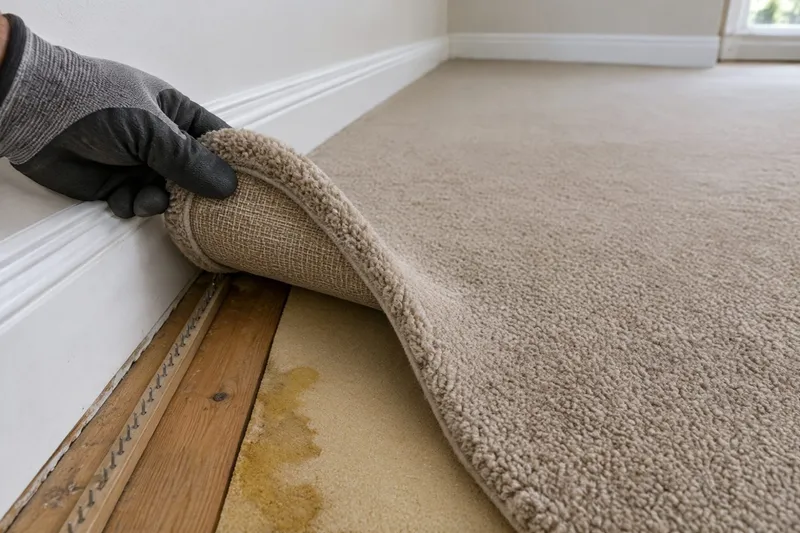
Some points that matter here:
- Replace enough padding. Expose enough to reach clean, odor-free material on all sides, and check the carpet backing, tack strip, skirting and subfloor at the same time. Replacing only the padding over a contaminated floor leaves the source in place.
- Sealing is not a shortcut. A sealer is for residual odor in a clean, fully dry porous floor. It should not be used over wet or heavily contaminated material. If particleboard or OSB is swollen or degraded, replacing it is better than painting over it.
- Ask a professional sooner when the area is large, several rooms are affected, wool is involved, you do not know what has been used before, or the smell returns after one or two correct treatments. Replacement makes sense when the carpet has permanent dye damage, the backing is delaminating, or padding stays strongly contaminated.
See The Clean Slate Protocol
Step 4: Stop It Happening Again
Cats do not urinate on carpet out of spite. House-soiling reflects an unmet medical, physical, social or environmental need, and even a spotless carpet will be used again if the cause stays.
Start with the vet
AAFP/ISFM guidelines recommend checking every house-soiling cat for medical disease. Urinary problems, kidney disease, diabetes, hyperthyroidism and arthritis can all play a part, and a cat in pain may learn to link the litter box with that pain and choose soft carpet instead.
Emergency signs
- Repeated straining with little or no urine, especially in a male cat. The AVMA describes a urinary blockage as a life-threatening emergency that needs immediate veterinary care.
- Crying, a painful or tense belly, or many unsuccessful trips to the box
- Blood in the urine, frequent small urinations or a sudden change in toilet habits need a prompt vet visit.
Set up the boxes properly
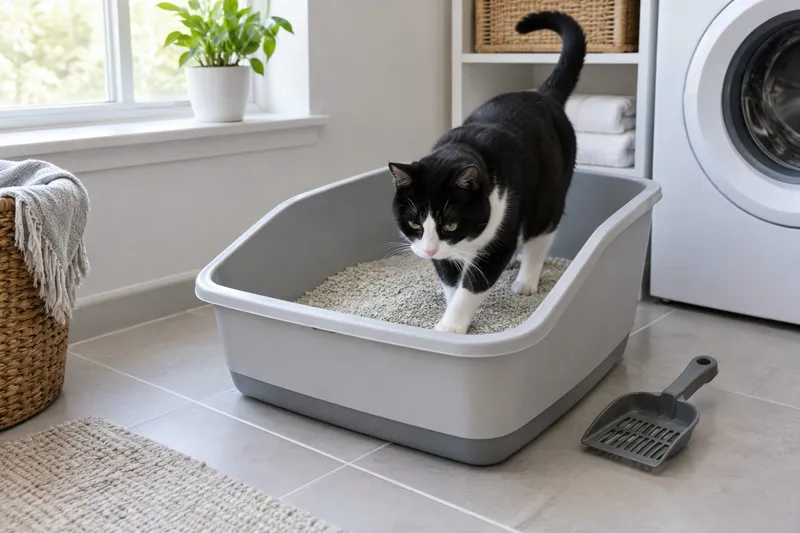
- One box per cat, plus one extra, in separate locations rather than side by side, with a box on each floor of a multi-level home.
- Go large. AAFP/ISFM suggests a box about 1.5 times your cat's length from nose to tail base.
- Quiet, accessible spots with an escape route, away from busy areas, food and water.
- Soft, unscented, clumping litter to start, scooped at least daily, and washed with mild soap and hot water rather than ammonia or strong fragrance.
- Low entry for older or arthritic cats.
Reduce stress, and never punish
Tension between cats is often subtle. Give each cat separate resources such as food, water, perches, hiding places and boxes. If outside cats are a trigger, block the view of them and think about the cat flap. Punishment raises fear, damages trust and can push urination to hidden spots.
A synthetic feline pheromone may be worth trying as an extra, but it is not a stand-alone cure. If accidents continue after a vet check and a good litter setup, ask your vet about a veterinary behaviorist. Our moving-house guide (linked below) covers the stress side in depth.
Common Questions
What is the best way to get cat pee out of carpet?
Blot up as much as you can with clean white towels, using firm pressure and never rubbing. Then apply a urine-specific enzymatic cleaner generously enough to reach the padding, follow the label for dwell time, and let the area dry completely before judging the result.
Why does the smell come back after I clean it?
Usually because urine was left behind in the backing, padding or subfloor, or because the product only masked the smell. The Carpet and Rug Institute warns that complete odor removal is unlikely unless the urine is removed from every layer it reached, and residue can become noticeable again on humid days.
Why does cat urine smell come back when it is humid?
When the liquid dries, a residue of uric acid crystals and salts can stay behind in the carpet. In humid air, or when the area gets damp, that residue can take on moisture and release its sharp smell again. A product that only masked the odor will not stop this, because the urine itself was never removed.
Does a UV flashlight prove a spot is cat urine?
No. Dried urine tends to glow under UV light, but laundry brighteners, some carpet backings, mineral deposits and cleaning residues can glow too. Treat a glowing patch as a clue worth marking and checking, not as proof.
Can I use vinegar and baking soda on cat urine?
They are fine for a quick fresh-spill clean-up, but neither reliably removes urine that has soaked into padding. Baking soda can absorb some moisture and odor but does not show the urine itself has gone. Never mix vinegar with bleach.
Should I steam clean cat urine out of carpet?
Not as the first step. The Carpet and Rug Institute advises against steam cleaning urine spots because heat can set the stain and the smell. Treat with an enzymatic cleaner first and bring in a professional if the odor persists.
How do I stop my cat peeing on the carpet again?
Start with a vet check, because pain and urinary disease commonly cause house-soiling. Then offer one litter box per cat plus one extra in separate spots, keep them clean, and never punish your cat. Cleaning the carpet properly removes the scent cue, but it does not fix the cause.
Sources: PetPlace; Hill's Pet; Carpet and Rug Institute (CRI) pet-urine technical guidance; IICRC consumer stain guidance; AAFP/ISFM house-soiling guidelines; American Veterinary Medical Association, Feline Lower Urinary Tract Disease; ASPCA; CDC; Washington State Department of Health.

Sophie Winslowe is a cat owner who spent 18 months researching and testing what actually helps with litter box problems, and turned it into The Clean Slate Protocol, a 30-day step-by-step plan.
Keep reading
- Senior cat peeing outside the litter box: causes and fixes — the red flags, the medical causes to rule out first and easier litter box set-up for older cats.
- Enzymatic cleaners: how effective are they? — how they work and how to use them.
- Cat peeing on bed: 7 reasons why and what to do — the emergency sign to watch for, how to clean a mattress and how to stop it.
- Best Black Light for Cat Urine — how to pick a UV flashlight and sweep a dark room to find hidden spots.
- How Often to Scoop a Cat Litter Box (and Change It) — a daily scooping and full-change schedule.
Ready for a Fresh Start?
Get the full 30-day Clean Slate Protocol, with six bonus guides and a 60-day money-back guarantee.
Learn More© 2026 Sophie Winslowe. All rights reserved. Privacy Policy • Terms & Conditions
This article is for general information only and is not veterinary advice. We do not offer medical, legal or other professional advice. Always consult your veterinarian before acting on any information related to your cat's health or behavior. Results vary and are not guaranteed.