
Best Black Light for Cat Urine: Why 365 nm Wins
By Sophie Winslowe • Updated November 2026 • 8 min read
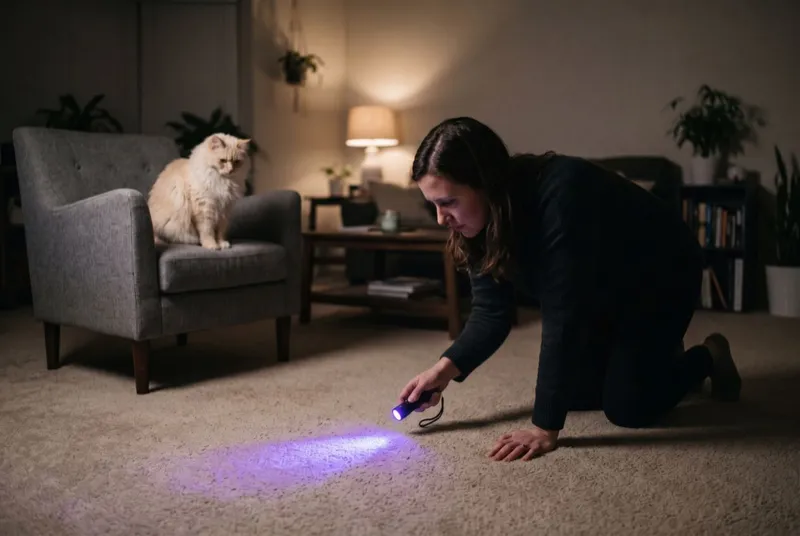
The smell is clearly there, but you cannot find the spot. A UV flashlight, often called a black light, is one of the best tools for tracking down dried cat urine in carpet, upholstery and along baseboards, as long as you pick the right kind and know what a glow does and does not mean.
The short version: a filtered 365 nm UV-A flashlight is the upgrade worth making, because it keeps the room dark enough for a faint glow to show. This guide explains why, compares three flashlights, and walks through a dark-room inspection step by step.
Key takeaways
- Choose a filtered 365 nm flashlight if faint or old marks are the problem. It gives better contrast than a typical unfiltered 395 nm light, which throws a lot of visible purple glare.
- A 395 nm light still has a place. It can show obvious dried contamination in a dark room, so it is a fair budget starting point.
- Dried urine is easier to see than fresh. Wet urine produces glare, and deep carpet contamination can hide below the beam.
- A glow is a clue, not proof. Detergent, cleaner residue and other spills glow too. Check by smell and touch before you treat.
- Protect your eyes. UV-A is not harmless. Never look into the beam or point it at people or pets.
In this guide
How a Black Light Finds Cat Urine
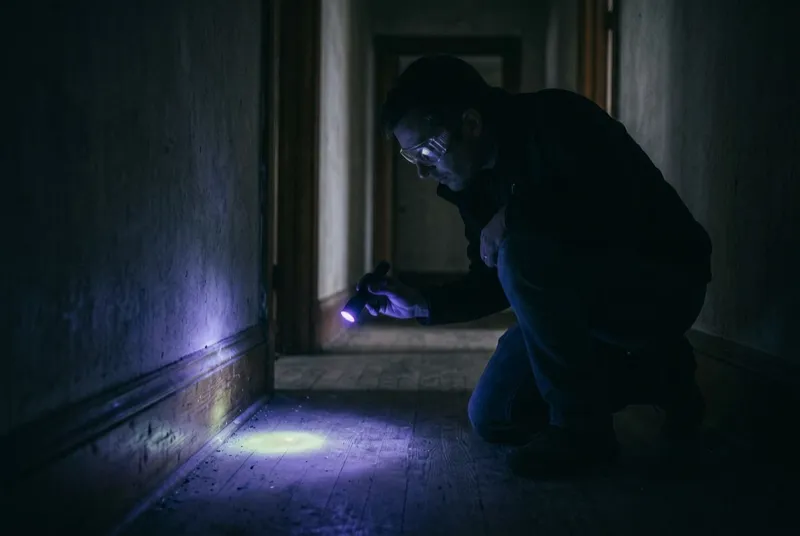
UV flashlights work through fluorescence: some compounds absorb invisible ultraviolet light and give it back as visible light. Dried urine contains several of these compounds, so a dried patch can show up as a dull yellow to yellow-green glow in a dark room.
Lab studies of what glows in urine have mostly used human urine. They point to natural pigments such as urobilin and urochrome, vitamin B2 compounds called flavins, and fluorescent oxidation products. Cat urine may be similar, but it has not been studied the same way, so treat the details as a guide.
365 nm vs 395 nm: Why Contrast Matters
The number on the flashlight is the peak wavelength of its LED. Both 365 nm and 395 nm sit in the UV-A band, and both can make urine fluoresce. The difference is how much visible light comes along with the UV.
A 395 nm LED sits so close to the edge of visible light that its beam looks strongly purple, and LEDs spread their output either side of the rated peak. That purple wash raises the background brightness, which makes a weak glow harder to pick out, a bit like spotting a candle next to a floodlight. A 365 nm LED puts out much less visible light.
What a filter does (and does not do)
Even a 365 nm LED leaks some visible blue and violet light. A visible-light-blocking filter, often a ZWB2 glass filter, absorbs most of that spill. The filter does not create the 365 nm wavelength or add UV power; the LED does that. What it does is clean up the picture, so clean carpet and walls look nearly dark and only genuinely fluorescent spots stand out. Some visible light can still get through.
Where does 395 nm fit?
A 395 nm light can still show strong, obvious dried contamination in a darkened room. Where it struggles is on older, lighter or partly cleaned marks, which are often the ones behind repeat marking. If your budget is tight, start with what you can get, and treat a filtered 365 nm light as the upgrade for the hard-to-find spots.
Three Flashlights Worth Comparing
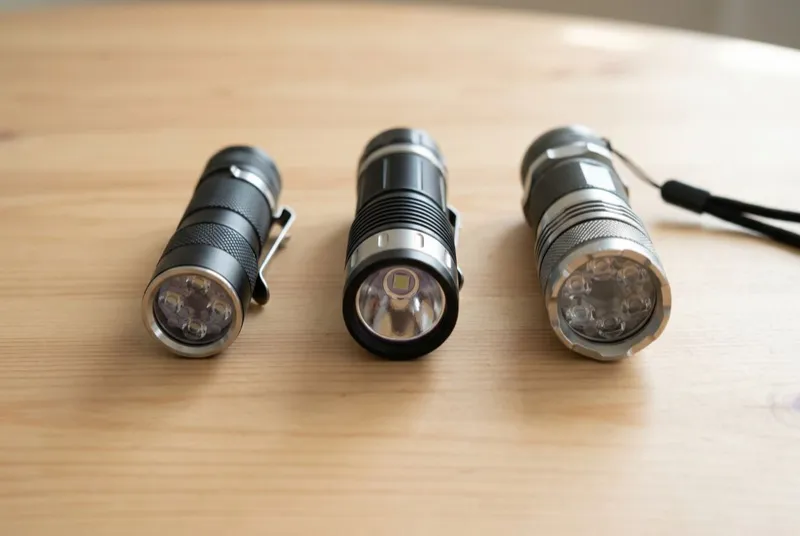
These three come up as filtered 365 nm options in an independent 2026 comparison of 28 consumer UV flashlights by 1Lumen, which ranked lights on UV power, throw, visible-light control and build quality. We have not tested them ourselves. Prices change often and stock varies by country, so check the current price and that the listing includes a ZWB2 or similar filter before you buy.
| Flashlight | Best for | What to know |
|---|---|---|
| Convoy S12 UV | Sweeping whole rooms | Three 365 nm emitters behind a ZWB2 filter, in a compact body that takes one 21700 battery. Ranked fourth for raw UV power in the 1Lumen test. It can get hot and step its output down on the highest setting, and the battery is usually bought separately. |
| Sofirn SF16 | Compact all-rounder | 365 nm with a filter and an 18650 battery. 1Lumen rated its build quality highly and found the bundled battery matched its labeled capacity. A smaller beam than a room sweeper, so it takes more passes. |
| Lumintop Tool AA UV | Pocket spot checks | A small filtered UV-A light that runs on an AA or 14500 battery. 1Lumen named it its top small-form and value pick. Good for a quick check, slower for a whole house. |
What to look for when you shop
- 365 nm and a visible-light filter. Check the listing says the filter is included, because some versions of the same model ship without one.
- UV output, not watts or LED count. A light with dozens of cheap LEDs or a big wattage number can reveal less than one good 365 nm emitter.
- A rechargeable battery from a reputable brand, if you will use it often.
- Skip 254 nm and 310 nm lights. Those shorter wavelengths are more hazardous to skin and eyes, and are not needed for finding stains.
How to Run a Dark-Room Inspection
Fresh versus dried urine, and why carpet is tricky
Dried urine is generally easier to spot than wet. A fresh puddle can add glare and reflection, and in a lab comparison of body fluids, fluorescence was weaker while a sample was wet and steadier once it dried. Carpet and upholstery foam are harder still, because urine can soak below the surface where the beam cannot reach. That is why a clear scan never fully rules out urine underneath.
A Glow Is a Clue, Not Proof
Plenty of ordinary household materials fluoresce, and some real urine stains do not glow at all. Treat every glowing patch as a lead to check.
| What you see | Likely cause | What to do |
|---|---|---|
| Dull yellow to yellow-green patch, irregular edges, drip lines | Possible dried urine | Confirm with the paper towel and smell test, then mark and treat. |
| Bright blue-white, even or ring-shaped | Optical brighteners in laundry detergent or carpet cleaner | Not urine on its own. Treat only if a urine smell remains. |
| Faint, steady glow where you cleaned before | Harmless residue left after treatment | Judge by whether the smell returns on a humid day, not by the glow. |
| Blue-green, white or pale yellow in odd places | Other fluids or spills, such as food, drinks or saliva | Use context and smell to decide. |
Protect Your Eyes
UV-A is not harmless
- Never look into the emitter, and never point the beam at people or pets.
- A filtered 365 nm beam can look deceptively dim, so you get less visible warning to look away.
- Watch for reflections off mirrors, windows, glossy tile and varnished floors.
- Wear UV-blocking glasses (rated UV400) for longer sweeps, and keep skin exposure short.
Found a Spot? What to Do Next
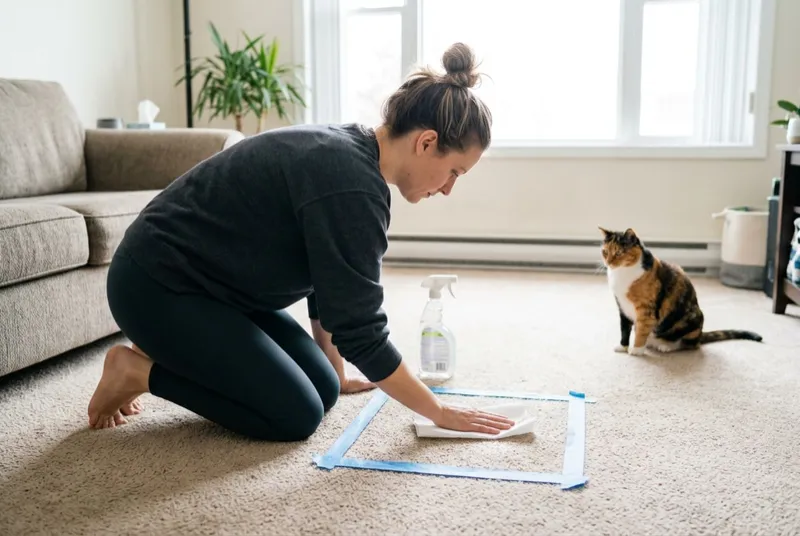
Once your spots are marked, the cleanup matters as much as the search. Our guide to getting cat pee out of carpet covers blotting, treating down to the padding and when the padding has to go, and how enzymatic cleaners work explains how to use them properly.
If your cat suddenly starts urinating outside the litter box, see your vet before assuming it is behavior. Repeated trips to the box with straining and little or no urine, especially in a male cat, is an emergency.
Common Questions
Does cat urine glow under a black light?
Often, but not always. Dried urine commonly shows as a dull yellow to yellow-green patch under UV-A light, yet many other things glow too, including laundry detergent residue, some cleaners and other spills. A glow is a lead to check by smell and touch, not proof of urine, and a spot that does not glow can still hold urine, especially deep in carpet.
Is a 365 nm or a 395 nm black light better for finding cat urine?
For faint or older marks, a filtered 365 nm flashlight usually gives clearer contrast, because a 395 nm light also throws a lot of visible purple light that can wash out a weak glow. A 395 nm light can still show obvious dried contamination in a dark room, so it is a reasonable budget starting point if that is what you have.
Can a black light find old stains I have already cleaned?
Sometimes it will still glow faintly, because harmless residues can stay in carpet backing, wood joints or concrete after the odor is gone. Judge success by whether the smell returns, especially on a warm, humid day, rather than by whether any glow remains.
Do I need a completely dark room?
Yes, as dark as you can make it. A strong flashlight may work in dim light for obvious stains, but closing blinds, turning off every light and giving your eyes a minute to adjust makes faint glows much easier to see.
Is it safe to use a UV flashlight around my cat and my eyes?
UV-A is not harmless light. Never look into the emitter, never point it at people or pets, and watch for reflections off mirrors, windows, glossy tile and varnished floors. A filtered 365 nm beam can look deceptively dim, so wear UV-blocking glasses (rated UV400) during longer scans. If you have any concern about your eyes or your cat's, ask your doctor or vet.

See The Clean Slate Protocol
Keep reading
- How to get cat pee out of carpet — blot, treat to the padding and stop the smell coming back.
- Enzymatic cleaners: how effective are they? — how they work and how to use them.
- Cat peeing on bed: 7 reasons why and what to do — the emergency sign, causes and how to clean a mattress.

Sophie Winslowe is a cat owner who spent 18 months researching and testing what actually helps with litter box problems, and turned it into The Clean Slate Protocol, a 30-day step-by-step plan.
Ready for a Fresh Start?
Get the full 30-day Clean Slate Protocol, with six bonus guides and a 60-day money-back guarantee.
Learn More© 2026 Sophie Winslowe. All rights reserved. Privacy Policy • Terms & Conditions
This article is for general information only and is not veterinary advice. We do not offer medical, legal or other professional advice. Always consult your veterinarian before acting on any information related to your cat's health or behavior. Results vary and are not guaranteed.