
Senior Cat Peeing Outside the Litter Box: Causes and Fixes
By Sophie Winslowe • Updated November 2026 • 9 min read
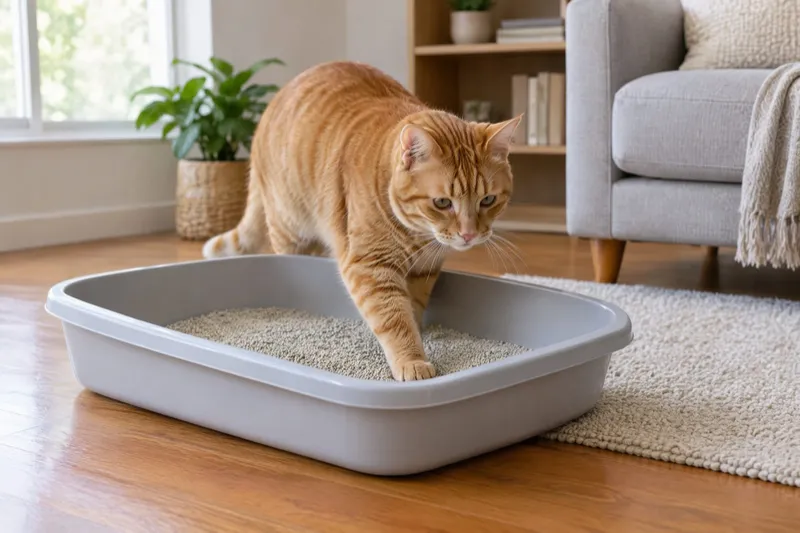
A senior cat that has used the litter box reliably for years and suddenly starts peeing on the floor is not being spiteful. In older cats the cause is usually physical, and a change in toilet habits can be the first sign of a treatable condition. This guide covers the emergency signs to check first, the common causes, what your vet will look at and the litter box changes that make toileting easier.
Key takeaways
- Check your cat is passing urine. Straining with little or no urine, especially in a male cat, is an emergency.
- Treat it as a medical sign first. New accidents in an older cat call for a vet visit before any behavior fix.
- Several causes often overlap. Kidney disease, other illnesses, arthritis and cognitive changes are all common in older cats.
- Make the box easier now. A large, open, low-entry box on every floor the cat uses, scooped daily.
- Never punish. It does not help and tends to make things worse.
In this guide
Is Your Cat Passing Urine? Check This First
Before anything else, make sure urine is actually coming out. A blocked urethra is a life-threatening emergency, and straining in the box is often mistaken for constipation.
Go to an emergency vet now if you see
- Repeated trips to the box with little or no urine, especially in a male cat
- Straining or crying out while trying to urinate
- Licking at the genital area or a painful, firm belly
- Vomiting, weakness, hiding or collapse
Male cats are at much higher risk because their urethra is longer and narrower, but any cat showing these signs needs urgent care rather than a wait-and-see approach at home (AVMA).
Why Do Older Cats Pee Outside the Litter Box?
It is rarely one thing. In senior cats the usual causes are illness, pain, age-related changes in thinking and awareness, and a box that no longer suits an older body, and several often occur together. That is why a vet check comes before changing litter or routines.
How common are these conditions in older cats?
Source: Cornell Feline Health Center (chronic kidney disease; degenerative joint disease). X-ray changes do not always mean a cat is in pain.
Kidney Disease and Other Illnesses That Increase Urine
Cornell Feline Health Center describes chronic kidney disease as affecting up to 40 percent of cats over 10 and 80 percent of cats over 15, often with no obvious early signs. Cats may drink and urinate more as the kidneys lose the ability to concentrate urine. Diabetes and an overactive thyroid also increase thirst and urine. Bigger volumes arrive with less warning, so a stiff or sleepy cat may not reach the box in time.
Bladder Pain, Infection and Stones
Urinary infections are more common in older cats, particularly those with kidney disease, diabetes or an overactive thyroid, and stones and other bladder problems also occur. A cat in pain can come to associate the box with discomfort and look for somewhere else. The signs overlap too much to tell apart at home, so urine tests are needed (iCatCare 2025 guidelines).
Arthritis and Hidden Pain
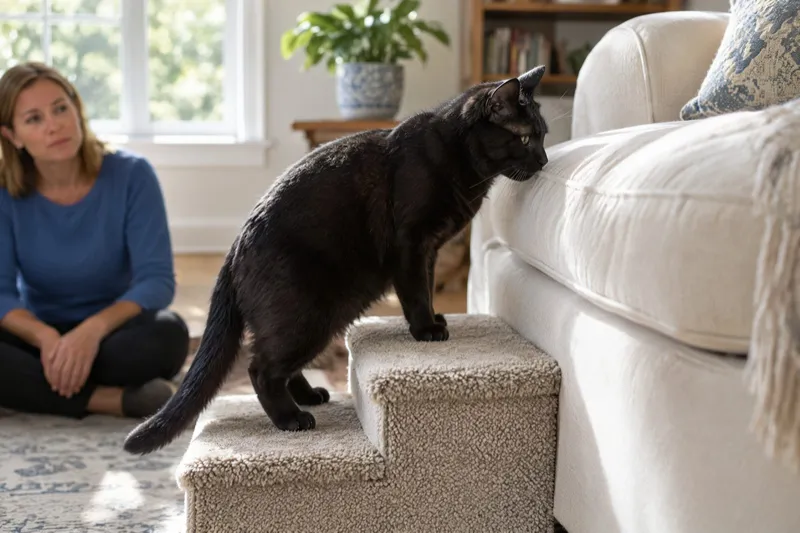
In a classic X-ray study cited by Cornell, 90 percent of cats over 12 showed evidence of degenerative joint disease. X-ray changes do not always mean pain, but cats hide it well and rarely limp. Instead, an arthritic cat may stop jumping, avoid stairs, or struggle to climb over a high box edge or squat comfortably, and may simply give up on the box.
Cognitive Changes (Feline Dementia)
Feline cognitive dysfunction is an age-related condition whose signs usually appear in cats around 10 and older. Cornell lists disorientation, staring, changes in sleep, loud night-time yowling and urinating or defecating outside the box among them. Because pain, high blood pressure and other illnesses can look the same, vets rule those out first, and some apparent dementia improves once pain is treated.
Poor Vision and Hearing
Failing eyesight makes a dark route to the box harder to follow, and a startled cat may avoid a spot where it was frightened.
The Box, the Home and Stress
A box that is too small, too high, dirty or tucked somewhere noisy can be enough on its own. Older cats also cope less well with change and may be pushed away from the box by a more assertive housemate. See our guide to why cats pee on the bed for more on the social and stress side.
Reading the Clues
Noting how and where accidents happen gives your vet useful clues. These patterns are a guide only, not a diagnosis:
| What you see | Possible cause to raise with your vet |
|---|---|
| Big puddles, big litter clumps, more drinking, weight loss | Kidney disease, diabetes or an overactive thyroid |
| Small, frequent spots, straining, blood in the urine | Bladder or urinary tract problem (an emergency if little or no urine comes out) |
| Pees beside the box, hesitates at the edge, avoids stairs, seems stiff | Arthritis or other pain |
| Wanders, stares, yowls at night, seems to forget the box | Cognitive changes, after other causes are ruled out |
| Sprays urine on walls, doorways or windows | Urine marking: stress or other cats, but check for bladder pain too |
| Leaks urine while resting or walking | True incontinence, which needs a vet exam |
What Your Vet Will Check
A typical senior work-up starts with a full physical exam including the joints and a neurologic check, and a blood pressure reading. Blood tests (kidney values, glucose and thyroid hormone) and a urinalysis are standard, a urine culture is added when infection is possible, and X-rays or an ultrasound may follow if stones or other problems are suspected (AAFP senior care guidelines). A negative urine dipstick does not reliably rule out infection in an older cat, and bacteria with no symptoms are not always treated, so leave that decision to the vet.
What to Bring
- Short videos of your cat entering, using and leaving the box
- A quick floor plan marking boxes, food, water and accident spots
- Notes on clump size, drinking, appetite, weight, jumping and night-time yowling
- Any medicines or supplements your cat takes
Do not give leftover antibiotics or any human pain medicine. Many are harmful to cats.
Making the Litter Box Senior-Friendly
Whatever the cause, an easier box helps, and these changes are low-risk to start before the vet visit.
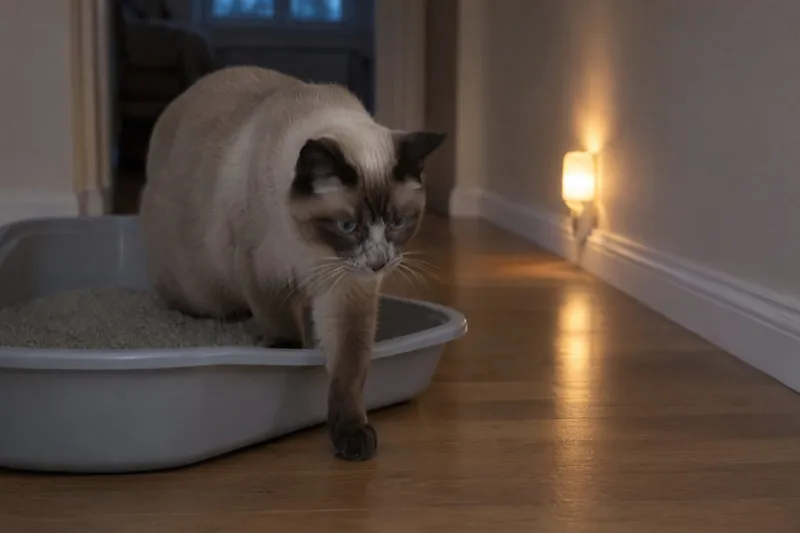
| Feature | What helps an older cat |
|---|---|
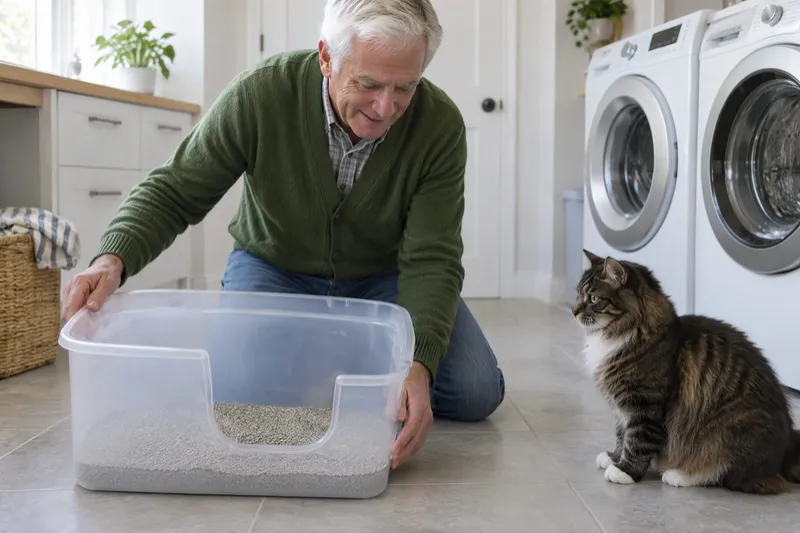
| Entry | A low entry, no more than a few inches high, or a large storage tote with a doorway cut into the front (smooth the edge). Add a step or ramp if needed. |
| Size | Large. A common guideline is about 1.5 times the cat's body length, and many cats prefer bigger boxes. |
| Number and spread | At least one more box than cats, with a box on every floor the cat uses and near where it rests. Avoid lining boxes up side by side. |
| Cover | Open is the safe default. Some cats accept a covered box if it is large with an easy exit. |
| Litter | Fine, unscented clumping litter about 1 to 2 inches (2.5 to 5 cm) deep. Avoid scented, dusty or rough pellet litter. Change one thing at a time. |
| Location | Quiet and easy to reach, away from noisy appliances and anywhere another pet can corner the cat. |
| Light | A night light along the route. |
| Cleaning | Scoop at least daily, more often if the clumps are large. Wash the whole box regularly with mild soap and hot water. No ammonia or strong chemicals. |
| Footing | A non-slip mat beside the box. |
Add an extra box near where accidents happen rather than moving the existing ones all at once, and keep food, water and bed within easy reach so there are no jumps or stairs. Cornell also suggests ramps for cats that struggle with steps and routine check-ups to catch problems early.
Cleaning Up Accidents
A cat may return to a spot that still smells of urine, so clean thoroughly: blot rather than rub, treat with an enzymatic pet-urine cleaner to the depth the urine reached, and avoid steam and ammonia-based products. Our guide to getting cat pee out of carpet walks through the steps, and how effective enzymatic cleaners are explains how they work.
What Not to Do
- Do not punish. Scolding or confining a cat does not fix house-soiling and tends to make it more fearful (AAFP/ISFM).
- Do not put it down to old age. A change in toileting is a reason to see the vet.
- Do not skip the vet for supplements or "UTI remedies." Evidence for most of them is limited.
Keep a Simple Log
Each week, jot down accidents and where they happened, clump size, drinking, appetite, weight, jumping and night-time yowling. It speeds diagnosis and shows whether changes are working. If accidents do not clearly improve after treatment and an easier box, tell your vet, since senior cats often have more than one problem at a time.

See The Clean Slate Protocol
Common Questions
Why is my old cat suddenly peeing everywhere?
Usually it is a physical cause, often more than one at once: kidney disease or another illness that increases urine, a painful or irritated bladder, arthritis that makes the box hard to reach, or age-related cognitive changes. A new pattern in an older cat deserves a vet visit before anything else.
Is it dementia if my older cat pees outside the box?
It can be, but cognitive dysfunction is only considered after medical causes, pain and high blood pressure have been ruled out, because those can look very similar. Disorientation, staring, night-time yowling and forgetting where the box is are the typical clues to mention to your vet.
How do I know if it is an emergency?
Go to an emergency vet if your cat keeps going to the box but passes little or no urine, strains, cries out, licks the genital area, vomits, seems weak or has a hard, painful belly. A urinary blockage mostly affects male cats and can become life-threatening quickly.
What kind of litter box is best for an arthritic cat?
A large, open box with a low entry, placed where the cat rests and on every floor the cat uses. A big shallow tray, or a storage tote with a doorway cut into the front (with the edge smoothed), is a common homemade option.
Should I punish my senior cat for accidents?
No. Punishment does not fix house-soiling and tends to make a cat more fearful, which can make accidents more likely. Treat the accident as a sign that something physical, social or environmental needs attention.
How often should an older cat see the vet?
Ask your vet. Older cats are generally checked more often than once a year, and regular blood pressure, blood and urine tests help catch kidney disease, thyroid problems and diabetes early. Book sooner for any sudden change in toileting.
Sources: 2021 AAFP Feline Senior Care Guidelines; AAFP/ISFM house-soiling guidelines; 2025 iCatCare lower urinary tract guidelines; Cornell Feline Health Center on chronic kidney disease, degenerative joint disease and cognitive dysfunction; American Veterinary Medical Association, Feline Lower Urinary Tract Disease. This guide is general information and is not veterinary advice: see your vet about any change in your cat's toileting.
Sophie Winslowe is a cat owner who spent 18 months researching and testing what actually helps with litter box problems, and turned it into The Clean Slate Protocol, a 30-day step-by-step plan.
Keep reading
- Cat peeing on bed: 7 reasons why and what to do — the emergency sign, causes and how to clean a mattress.
- How to get cat pee out of carpet — blot, treat to the padding and stop the smell coming back.
- Enzymatic cleaners: how effective are they? — how they work and how to use them.
- How Often to Scoop a Cat Litter Box (and Change It) — a daily scooping and full-change schedule.
Ready for a Fresh Start?
Get the full 30-day Clean Slate Protocol, with six bonus guides and a 60-day money-back guarantee.
Learn More© 2026 Sophie Winslowe. All rights reserved. Privacy Policy • Terms & Conditions
This article is for general information only and is not veterinary advice. We do not offer medical, legal or other professional advice. Always consult your veterinarian before acting on any information related to your cat's health or behavior. Results vary and are not guaranteed.